
Events
ART LEGACY: HÌNH TƯỢNG TRÂU TRONG TRANH LÊ THIẾT CƯƠNG – CHIẾC CỘT CHỐNG ĐỠ NỀN VĂN MINH LÀNG XÃ
In the flow of contemporary Vietnamese art, adopting animal imagery as an evocative "pretext" to channel the transitional sentiments of a changing year, bidding farewell to the old and welcoming the new, has long been a beautiful tradition among artists. Rooted in this sacred emotional thread, the buffalo under the lens of painter Lê Thiết Cương possesses a highly distinctive identity.
For Lê Thiết Cương, the inspiration for sculpting this zodiac animal stems deeply from his native roots. As he wrote in his essay "Welcoming the Year of the Buffalo 2021": "Vietnamese art originates from the village. Vietnamese art is village art. Vietnam is a country of villages. The civilization of the Vietnamese people and the Vietnamese nation is a wet-rice civilization." For this reason, the painter compares the image of the buffalo to the pillar of Vietnamese culture and civilization. The closeness and familiarity of this animal, intertwined with its industrious, diligent, and robust nature, became the perfect material for the artist to weave into his works as a wish for health and peace for everyone as the new year knocks on the door.
The image of the buffalo in traditional Vietnamese art has always been diverse, stretching from 17th-century wooden reliefs in village communal houses to young boys playing the flute or flying kites in Đông Hồ folk paintings. To avoid repeating his predecessors, Lê Thiết Cương chooses his own path through a minimalist language. He strips away and discards redundant, realistic details, using simple strokes and primal color blocks to refine and retain the "spirit," robustness, and gentle nature of the sacred animal.
Trong dòng chảy của mỹ thuật đương đại Việt Nam, việc mượn hình tượng các con giống làm "cái cớ" gợi cảm, gợi hứng cho tâm trạng giao niên, tiễn cũ đón mới từ lâu đã trở thành một tục lệ đẹp của các họa sĩ. Nằm trong mạch cảm xúc thiêng liêng ấy, hình tượng con trâu dưới lăng kính của họa sĩ Lê Thiết Cương mang một căn tính rất riêng.
Đối với họa sĩ Lê Thiết Cương, nguồn cảm hứng tạo hình linh vật này bắt nguồn sâu thẳm từ gốc rễ quê hương. Như ông đã viết trong bài "Đón Sửu 2021": "Nghệ thuật Việt khởi đi từ làng. Nghệ thuật Việt là nghệ thuật làng. Nước Việt là nước làng. Văn minh của người Việt, nước Việt là văn minh lúa nước." Chính vì thế, họa sĩ đã ví von hình ảnh con trâu như chiếc cột của ngôi nhà văn hóa, văn minh Việt. Sự gần gũi, thân thuộc của loài vật này, gắn liền với tính cách cần cù, chăm chỉ và khỏe mạnh, đã trở thành chất liệu tuyệt vời để người nghệ sĩ gửi gắm vào tác phẩm như một lời chúc sức khỏe, an lành cho mọi người khi năm mới gõ cửa.
Hình ảnh trâu trong nghệ thuật truyền thống Việt Nam vốn rất đa dạng, trải dài từ những bức phù điêu gỗ thế kỷ 17 ở đình làng cho đến những chú bé thổi sáo, thả diều trong tranh Đông Hồ. Để không lặp lại các bậc tiền bối, họa sĩ Lê Thiết Cương chọn một lối đi riêng bằng ngôn ngữ tối giản. Ông bóc tách, lược bỏ các chi tiết tả thực rườm rà, dùng các nét vạch đơn giản và mảng màu nguyên sơ để chắt lọc, giữ lại cái "thần", cái khỏe khoắn và thuần hậu của linh vật.
Related Artciles

Art Legacy
KÝ HỌA LỊCH SỬ
“No other conflict saw as many sketches as the Vietnam War. War sketches are a unique, specialized genre in Vietnamese painting. Most of the artists were soldiers themselves; they painted their own lives, painted themselves, and were an integral part of the war rather than outsiders looking in. For them, a passion for art, devotion to their craft, and patriotism were one and the same. Loving art and loving the nation were inseparable—neither forced nor performative, but as entirely natural as breathing.
These wartime sketches carried the ultimate price of life and death. That is why, even after more than half a century, looking at them still feels as though they were drawn just moments ago. They remain 'hot,' vivid, and overflowing with the atmosphere of war; one can almost 'hear' the roar of bombs and bullets echoing from every stroke. From 1954 to 1975, ultimately, the entire nation walked a single, unified path—the path of waging war to reunite the country.
[...]”
— From "Conversations with Painting" by artist Lê Thiết Cương
Looking back through history, these wartime sketches serve as more than mere visual records of a turbulent era; they stand as a living testament to art's profound companionship with the nation's journey. Art in those days did not stand idly on the sidelines, but marched straight to the front lines, ever faithful beside the soldiers.
Art Legacy
HẠT GẠO
In praise of “The grains of Rice” Vietnam is one of the rice granaries in Southeast Asia. Rice cultivation involves much hard work. There is a Vietnamese saying which goes:
“You who taste a bowl of rice,
Do you feel in the fragrant grains,
All the pains I’ve taken to grow then?”
So much hard work is required, yet the farmers are not sure whether they have a bumper crop, because all their efforts depend on,,,the Heaven, Nobody knows where He is, but everybody is afraid of him. From generation to generation, every Vietnamese farmer knows this incantation:
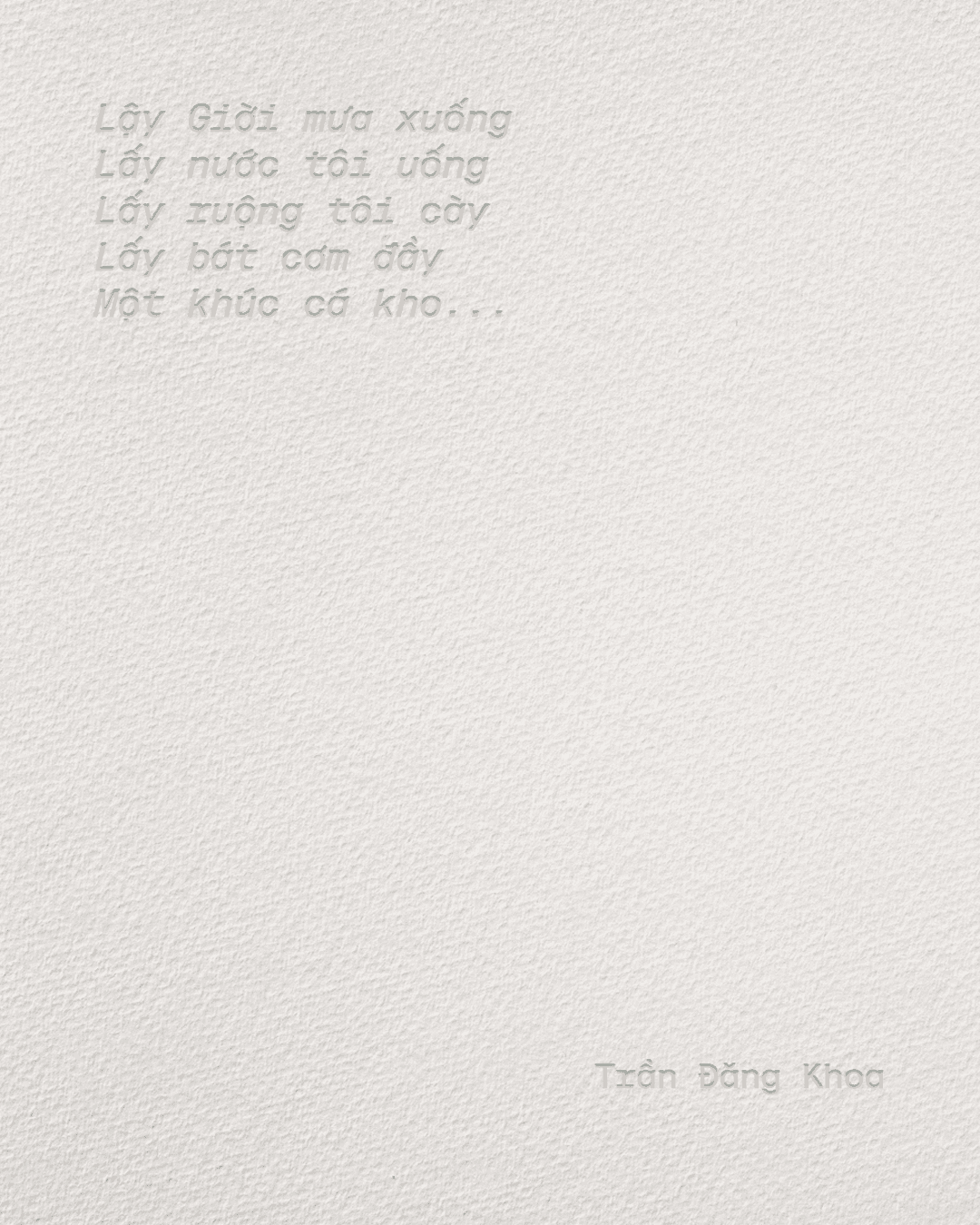
We beg the Heaven to make rain fall
So that we have water to drink,
Rice fields to cultivate
A bowl of rice
A piece of stewed fish…
The age-old dreams of the farmers contain merely some water, a bowl of rice, and a piece of fish. These fundamental things are not easy to get at all. There was a time when farmers suffered from chronic hunger. Thanks to the doi moi process, Vietnam now ranks second among rice exporters in the world. This good news reveals that poverty and hunger have been reduced. To make rich, however, we need to rely on our resources, the most valuable of which is the “brain”. Only when Vietnam exports its “brain” can it be able to transform into Dragon and take off. A single hi-tech product measures just a few grams but it exceeds tens of tons of rice in terms of value.
In the meantime, we need to rely on the grains of rice. At present or in the future, we still need them.
[...]”
— Foreword to the book “Hạt Gạo” (The Grain of Rice), written by poet Trần Đăng Khoa.

Art Legacy
ART LEGACY: HẠT GẠO
“Rice has accompanied the Vietnamese people for over 2,500 years.
Rice not only sustains the physical life of the Vietnamese but also shapes their spiritual life. The village fields stretching from the Red River Delta, the Central plains, to the Mekong Delta… vividly reflect the image of a wet-rice civilization.
The village is the fundamental unit that creates Vietnam. Vietnam is the village; Village – Nation. All forms of Vietnamese art originate from the village: village communal houses, village temples, village festivals, traditional theater performed in the village square, water puppetry at the communal hall, performances at the village gate… There is no Vietnamese person without their village roots within them.
[...]
Through Rice, one sees the Vietnamese people; through the Vietnamese people, one perceives the grain, and recognizes the spiritual DNA of Vietnam.
Rice, a Mother.”
Le Thiet Cuong
7.2025